

Khadimul Islam
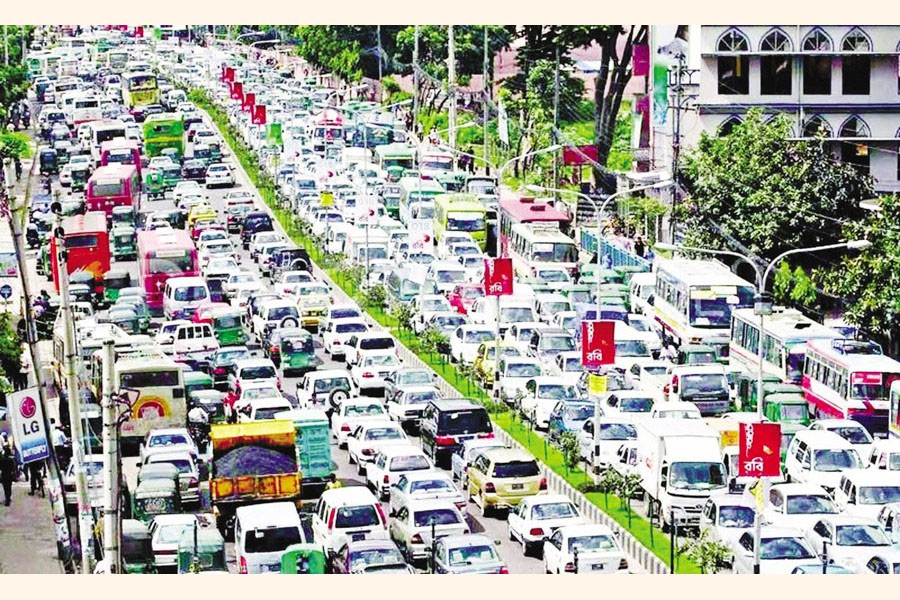
Dhaka, The capital of Bangladesh, is home to 24.70 million people. In Dhaka, people from different districts of the country have been moving to Dhaka for various Institutions, including Central Offices, Ministries, Supreme Court, Universities, Jobs/Employment, and Commercial reasons, at a large rate for the last 15 to 20 years. As a result, due to the excess population compared to the area, traffic congestion has increased on the roads and tragic accidents have occurred at various times. In this discussion, the causes of traffic congestion in Dhaka city, how traffic congestion can be avoided, what are the alternative ways, and the responsibility of the public and the law will be given special importance. Recently, most areas of Dhaka city have often become uninhabitable due to traffic congestion and air pollution. If this traffic congestion cannot be brought under control quickly, Dhaka city may become uninhabitable. The discussion will discuss the traffic congestion system of the European country Netherlands and the traffic congestion system of Bangladesh through the law.
Excessive traffic congestion in Dhaka city. Some visible reasons are: excessive density of people, uncontrolled urbanization, mismanagement of traffic, corruption, traffic signals, road structure design, parking problems. Rickshaws, CNG, Uber-Pathao also do not have any specific laws and policies for them. Some other important reasons for traffic congestion are lack of public transport, movement of expired transport, unlicensed rickshaws, footpath encroachment and various other problems. Overtaking competition of public transport, encroachment of entire road lanes. Especially in the capital Dhaka from Rampura to Badda, Kuril Bishwa Road, Gulistan-Nawabpur, New Market Mirpur Road, all these important roads are jammed most of the day due to traffic congestion. Due to this, the daily life of the common people has become miserable. There are also some broken roads on the side of the road, which increases the traffic congestion due to less and more speed. Due to many other small and big reasons, the capital Dhaka is becoming a city of discomfort.
There is a specific law (The Road Transport Act, 2018) to control traffic congestion and transport in Bangladesh, but there are weaknesses and limitations in its practical implementation. Lack of coordination between DTCA, BRTA, and City Corporation. If you disobey traffic signals, do not have a driving license, do not have a transport registration, or drive a vehicle with expired fitness, you can often get a discount by bribing the traffic police. There are specific penalties and fines for violating these laws in the Road Transport Act, but it is hardly implemented properly in Bangladesh. Air pollution is caused by the movement of vehicles without fitness on important roads, and the number of traffic jams and accidents is increasing regularly. This law has weak measures against unfit vehicles, there is no specific law and policy for ride-sharing in passenger transport, and there is no clear policy for rickshaws and CNG. It is not clear that steps will be taken to register additional vehicles. The number of vehicles is increasing day by day due to the lack of specific city-based quotas in BRTA’s policy.
Section 121 of the Road Transport Act, 2018 states that the government will undertake and implement digitization activities to provide improved services in the road transport sector. But even after 6 years of the law being made, appropriate effective initiatives have not been taken yet. The effectiveness of digital signal lights and automatic case systems and digital tracking systems in Bangladesh is very limited and weak. Sections 4 to 13 have made driving licenses of drivers and helpers mandatory and there are also specific punishments for driving without a license illegally. Sections 18 to 23 prohibit the movement of vehicles without fitness and jail and fines can be imposed if the fitness is expired, but on the other hand, the enforcement of the law is very weak, the amount of jail and fines is low. Currently, there are a lot of unfit buses in Dhaka city, due to which the environment is polluted, traffic jams and suffering of passengers and the public are increasing due to additional illegal buses.
In the discussion, compared to other countries, the Road Traffic Act, 1994 (Wegenverkeerswet 1994) of the European country Netherlands has strict penalties for violating certain laws. Bangladesh also has provisions for punishment for violating certain laws, but its law enforcement and negligence are very weak. Due to some important measures and laws of the Netherlands, their traffic congestion is very low, pollution and accidents are also very low. For example, the roads have separate lanes for bicycles, buses, and cars, which avoids collisions with cars. Violation of traffic laws is automatically fined (using sophisticated camera technology). Sensor-based traffic lights analyze road usage and provide signals. There is a system to enter the city by leaving the car outside the city and using public transport. They have mandatory training and license tests.
If some effective steps are taken in Bangladesh, it will be possible to control traffic jams in Bangladesh. First of all, it is necessary to take responsibility for the drivers of buses, rickshaws, CNG and ride-sharing. Pedal-powered rickshaws should be canceled and electric or battery-powered rickshaws should be introduced, and their operation should be banned on major highways and its legal enforcement should be strengthened. In addition, steps should be taken to make rickshaw drivers’ licenses mandatory and provide them with proper training. This will greatly reduce traffic congestion on major roads and the number of accidents will also decrease due to the caution of drivers. Separate lanes for rickshaws and CNG and separate lanes for buses and heavy vehicles or flyovers should be used as an alternative. Unfit vehicles should be banned. The quality of Dhaka’s city roads should be improved. Smart Traffic Management System should be introduced at every intersection along with the introduction of traffic cameras and e-challans, so that there will be no system of taking bribes. Illegal constructions on the sidewalks of the roads should be strictly eliminated and illegal parking on the side of the roads should be strictly suppressed. Parking cars outside the city and arranging public transport will reduce traffic congestion. Providing licenses to qualified candidates by introducing adequate training systems. Specific policies should be mentioned in the law for ride-sharing services such as Pathao, Uber, InDrive. Especially teaching traffic laws to school and college students. I believe that if the above-mentioned elements are added to the Road Transport Act, it will be easier to avoid traffic congestion in the capital Dhaka. At the same time, DTCA, BRTA and City Corporation should coordinate and play an effective role in reducing traffic jams. If the above methods are adopted, traffic jams and traffic congestion can be controlled.
The author is a student of law at Presidency University